Govern, Build, Own: The Three Architectural Disciplines for Production-Grade AI

Intent Solved Position Paper | July 2026
Executive Summary
- 1. Govern It: Risk has shifted from employee chat inputs to vendor-embedded AI and live agentic execution. Governance must move from static PDFs into engineered execution controls (API scopes, state machines, runtime sandboxes).
- 2. Build It Right: Avoid the Plumbing Fallacy—spending expensive probabilistic tokens on mechanical integration tasks while attaching recurring compute cost and masking process debt.
- 3. Own It: Audit token ROI, enforce a deterministic baseline first, and maintain edge/local model optionality to keep commercial leverage and data sovereignty.
The Hard Hat Era of AI has arrived. Enterprises are no longer piloting autonomous capabilities in sandboxed environments. Agentic workflows are live. Agentic coding tools are generating production code. Multi-system integrations are running on probabilistic models across core business infrastructure.
The friction many organisations are now experiencing is not a sign of failure. It is the natural consequence of moving fast through an adoption period that rewarded speed. Systems built for the pilot phase are now carrying production load, against production consequences, and the gap between the two is showing. The encouraging part is that closing that gap is known, well-understood engineering work. It does not require a reset. It requires discipline applied in three places.
Three disciplines separate the enterprises that will hold from the ones that will struggle: governing the execution layer, building on deterministic foundations, and owning the architectural decisions long enough to keep genuine options open.
Underneath all three sits a truth that every technology wave of the last twenty-five years has confirmed. Integration and data remain the core business problem. ERP, CRM, and digital transformation each promised to resolve it, and each left some portion of it behind. AI will not be the wave that finally absorbs that backlog on its own, because AI depends on the same foundations the previous waves did. A model reasoning over fragmented systems and a decade of unstructured files in SharePoint inherits that mess. It does not resolve it. Organisations that put genuine effort into their data and integration foundations now are not doing preparatory work for AI. They are doing the work that makes AI pay.
1. Govern It: Engineering Control Into the Execution Layer
The governance that lived in a PDF is obsolete. Not outdated. Obsolete.
That is no criticism of the organisations that wrote it. During the first wave of enterprise AI adoption, governance was appropriately a documentation exercise. Acceptable use policies, data liability frameworks, and workforce education matched the risk of the time: an employee pasting sensitive data into a chat interface. The risk has since moved, and governance now needs to move with it.
Two developments have redrawn the exposure map.
Vendor-embedded AI. The major enterprise SaaS platforms have integrated AI processing directly into their core product lines. Features that ingest, summarise, and ground internal data on vendor infrastructure are arriving through routine product updates rather than explicit opt-in decisions. The practical question for most organisations is no longer what employees are pasting into web interfaces. It is whether existing Master Services Agreements still describe what vendors are actually doing with corporate data under their current model-grounding architecture. This is a solvable contractual and technical review, and the organisations running it now are getting ahead of an exposure that exists whether or not an internal usage policy does. For Australian enterprises, this review also connects directly to obligations already in force: APRA-regulated entities carry material service provider requirements under CPS 230, and the ongoing Privacy Act reform program continues to raise the bar on how personal information is handled by third parties. Governance at the execution layer is not a new compliance burden. In many cases it is the practical mechanism for meeting obligations the organisation already holds.
The expanded execution surface. The adoption of standardised connectivity frameworks such as the Model Context Protocol has given local and cloud-based agents direct, multi-system tool-calling capabilities. These agents operate on probabilistic reasoning, not deterministic logic. An unhandled error loop or an ambiguous tool call is no longer a bad text response. It is a live database write, a corrupted record, or an unauthorised system event. The blast radius of a governance gap has grown by an order of magnitude, and so has the value of closing it.
Governance can no longer live in a compliance folder. It must be engineered into the execution layer: automated sandboxing for agent execution, strict state-machine boundaries, explicit API scopes, and continuous payload monitoring. A policy document does not prevent an agent from executing a malformed tool call. A properly scoped API boundary does.
Two further points round this out. First, controls need owners. An API scope with a named engineering owner and a review cadence stays current; one without either drifts. The organisations doing this well treat runtime governance as an operating capability with accountability attached, not a one-off hardening project. Second, the workforce didn't wait for governance to catch up, and that is an asset. These tools are part of daily practice across every function, which means the appetite and the skill are already in the building. The opportunity in 2026 is to channel that energy through well-governed pathways rather than around them. Workforces given sanctioned, capable tooling consistently choose it over workarounds.
2. Build It Right: The Plumbing Fallacy
The democratisation of software development through agentic coding tools is a genuine operational accelerator. Domain experts can prototype workflows in hours. Applications that once took weeks to scope are running in days. The velocity is real.
So is the risk it masks. When large volumes of code are generated without architectural verification, well-documented patterns follow: insecure API key management, hardcoded endpoints, and blind spots that standard unit testing frameworks miss. Accelerated code generation demands accelerated architectural verification. The two work as a pair, and organisations that keep them paired get to keep the speed.
The deeper pattern to watch for is the Plumbing Fallacy: the assumption that because a model can reason through complex instructions, it should serve as the primary connective tissue between disconnected enterprise systems.
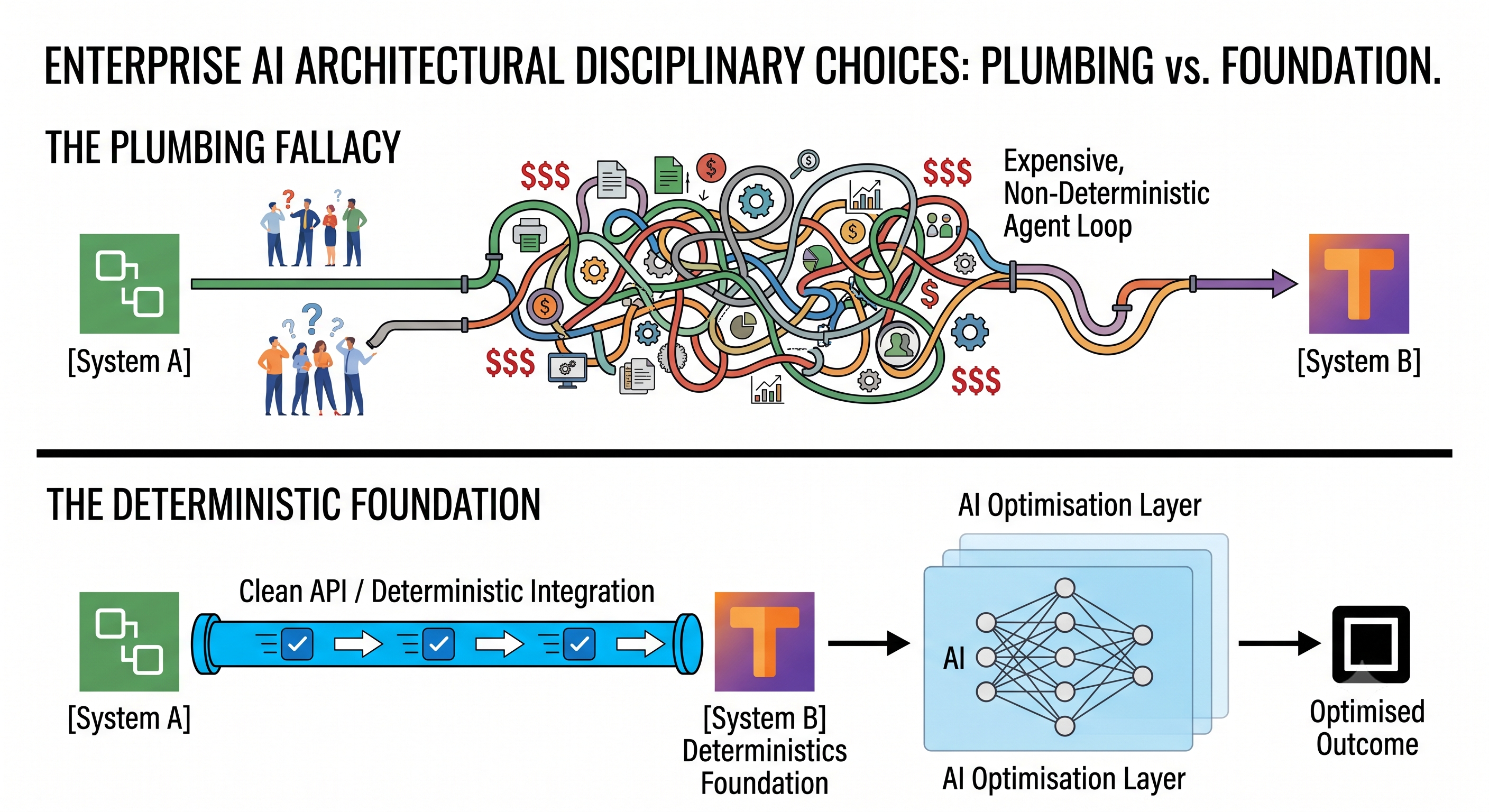
It is worth being honest about why this pattern is so tempting. Enterprise integration is genuinely hard, and it has been the most persistently unfinished discipline of the last twenty-five years. Most organisations carry an integration estate shaped by successive eras of point-to-point connections, middleware, and platform migrations. An agent that can reason its way across that landscape looks like a shortcut through years of deferred work. The instinct is understandable. It is also worth resisting, for two reasons.
The token cost of deterministic tasks. Using a neural network to repeatedly move and format data between systems attaches a recurring, fluctuating compute cost to a mechanical process that a stable integration pipeline handles for a fraction of the price, with zero variance. Return on Intent goes negative before the workflow has run a week. Capital is being spent on reasoning for tasks that require none.
The masking of process debt. Automating a broken workflow does not fix it. An autonomous agent executing a fragmented process runs that fragmented logic at scale, concealing underlying data mismatches and edge-case gaps until the workflow strains under production load. Many organisations stuck between pilot and production are experiencing exactly this, and the encouraging diagnosis is that the workflows are recoverable. The work sits at the process and data layer, and it is work the organisation can see, scope, and own.
Good integration delivers in its own right. A well-designed business process, supported by clean deterministic integration and the right business rules, produces repeatable and consistent outcomes, and for a large share of enterprise workflows that is the complete answer. Not every workflow needs AI in the loop, and recognising the ones that do not is a mark of maturity rather than caution.
The compounding benefit is the real prize. A sound integration foundation is not merely a defensive asset. It is the platform that makes agentic capability safe and valuable to add. AI is an optimisation layer, not a replacement for systems engineering. Agents perform superbly as cognitive operators on top of a well-mapped architecture, handling the ambiguous, judgement-heavy work that deterministic systems cannot. They struggle when asked to serve as the plumbing itself. Organisations that sequence it this way get both: the reliability of engineered process and the leverage of intelligence layered where it earns its place.
One discipline underwrites all of it. Designing, mapping and understanding the process flow remains the organisation's work. An agent can execute a workflow. It cannot replace the discipline of understanding one. Organisations that keep that understanding inside the team, rather than solely inside the model, own their processes in the way that matters.
This is the build layer, and it carries the governance layer with it. Controls are only as strong as the architecture they sit on.
3. Own It: Fit-for-Purpose Model Strategy
The current pricing environment for frontier AI models reflects a classic platform land grab, and the capital flows make the direction readable. Reports indicate Anthropic's run-rate revenue crossed $30 billion in April of 2026 and $47 billion by late May. Google is understood to have committed up to $40 billion to the relationship: $10 billion invested immediately, the remainder contingent on performance targets, structured around five gigawatts of compute capacity on Google Cloud. Amazon has expanded its own commitment in the same period. Providers are investing ahead of margin to entrench usage patterns and capture enterprise share, and today's aggressive price competition is a feature of that phase rather than a permanent condition.
Dependency, in this environment, is not a technology risk. It is a commercial one. And it compounds quietly.
None of this is a reason to hold back from frontier models. Where a frontier model delivers genuine Return on Intent on complex, ambiguous reasoning, the premium is well spent. The point is narrower and more practical: this is an adoption period, access economics will shift as the market matures, and the organisations best placed for that shift are the ones that matched their architecture to their actual need while options were easy to explore.
Three habits build that position.
Token ROI auditing. Treat model tokens as a direct variable cost, the way a manufacturer treats materials, rather than as an infrastructure subscription. Complex, ambiguous reasoning earns frontier pricing. Predictable classification, structured data routing, and template transformation are well served by more cost-effective systems. Every token spend can justify itself against the output it produces, and organisations that build this reflex early carry it as a permanent margin advantage.
The deterministic baseline. Before routing a task to a language model, it is worth asking whether a standard database query, a regex pattern, or a traditional automation script completes it faster, cheaper, and with zero probability of hallucination. Tasks that pass that test belong there. AI is not the default answer. It is the answer when nothing else is sufficient, and organisations that hold this line keep their AI spend concentrated where it genuinely compounds.
Model optionality, including at the edge. Capable AI now exists well beyond the frontier tier, and the gap for well-scoped tasks continues to narrow. Purpose-fit smaller models, including models run on-premises or on edge infrastructure, deserve a place in the evaluation set for three reasons. The first is cost: a task carrying frontier pricing today may be handled effectively by a smaller model tomorrow. The second is data sovereignty: organisations working with highly sensitive or personally identifiable data that cannot leave the network can still bring genuine AI capability to that data, on infrastructure they control. The third is negotiating position: an organisation that has practically explored its alternatives, even without switching, negotiates every renewal from knowledge rather than dependency. Model deprecations, API changes, and provider decisions all land differently when a realistic path forward already exists.
Owning it does not mean building private infrastructure for its own sake. It means owning the decision: understanding which models genuinely suit which tasks, keeping the practical ability to move between them, and letting the workload rather than the vendor determine the architecture.
Where to Start
These three disciplines are not equally urgent for every organisation, and the right entry point follows the exposure.
Organisations still mapping what their SaaS vendors do with their data under current model-grounding architectures will get the fastest risk reduction from the governance layer. That exposure is live independently of any internal agent activity, and it is also the most contractually recoverable.
Organisations with autonomous workflows in production that grew up on agent loops rather than clean integration will get the most durable value from the architecture layer. Every workflow moved onto deterministic foundations both reduces cost today and creates the base for the agentic capability that comes next.
Organisations whose core systems carry deep cloud API dependency will benefit most from building the option set early. Exploring alternatives is dramatically cheaper before it is urgent, and the exploration itself strengthens every commercial conversation in the meantime.
Most organisations have some exposure across all three, and the sequencing matters less than the decision to treat these as engineering questions with owners, rather than policy questions with documents. Governance documentation remains the right starting point. The opportunity this paper is pointing at is the space between the document and the technical control that enforces it.
The Discipline Is the Advantage
Building a sustainable, AI-augmented enterprise is not a choice between cloud dependency and infrastructure isolation. It is a discipline applied consistently across the governance, architecture, and commercial layers of the business, resting on the foundation every previous technology wave has pointed back to: integration done properly and data treated as the asset it is.
The organisations that will hold competitive ground are not necessarily the ones that adopted AI fastest. They are the ones that governed it at the execution layer, built on deterministic foundations, and kept genuine ownership of their model choices. That combination does not happen by accident, and it is available to any organisation willing to do the work.
The Hard Hat Era rewards the builders, not the adopters. Building is a skill enterprises already have.
Intent Solved is a specialist AI engineering practice helping Australian enterprises turn AI intent into execution. We work with organisations that have started their AI programme but need help maturing their capabilities, enabling their workforce, and realising return on their technology investments.

Steven Muir-McCarey
Director
I'm a seasoned business development executive with impact across digital, cyber, technology and infrastructure sectors; anchors customer and partnership pipelines to boost revenue for key growth.
Expert at navigating diverse business operations across enterprise and government organisations, solving complex challenges using domain experience with innovative technologies to deliver effective solutions, adept at landing cost efficiencies with improved resource utilisations into programs of importance.
I'm known for developing trusted stakeholder relationships, working with teams and partners to foster better joint collaborations that strengthen and elevate the opportunity aligned to business strategy.
With two decades of experience, I bring customers to brand by understanding, engaging and aligning needs that marries the solution from the right technologies so as to arrive at the desired destination in the most cost-effective way.
I bring an open mindset and authentic leadership to everything I do, and I specialise in anchoring good business fundamentals with acumen that orchestrates longevity for market success.
Whether in public or private enterprises, my track record in achieving repeated impact remains visible in industry solutions available today; I thrive in helping customers to leverage and sequence advancements in technologies to achieve better business operations.